

The 2022 National Forest Inventory conducted by IGN, our national geographic institute, recorded that forests cover nearly one-third (31%) of metropolitan France. And the data shows a slight growth trend.
Approximately two thirds of this area consists of various hardwoods, while the remaining third is softwoods. However more than half of the trees harvested yearly by volume are softwoods. This disparity is driven by higher demand for construction wood and significantly shorter production cycles for softwoods.
This chart illustrates the distribution of major tree species:
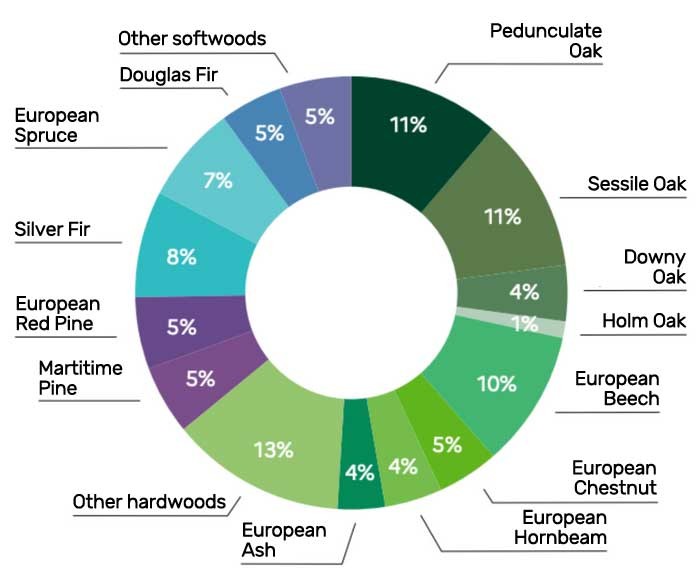
– credit @IGN – https://inventaire-forestier.ign.fr/
In English-speaking countries , the distinction is made between softwoods and hardwoods, but I find the terminology a bit misleading, even if true most of the time: some hardwoods can be incredibly soft and light, take Balsa for instance which is used to build model planes, or even Poplar which is better used for wood pulp production to make paper. While some Pine species can be quite honorably dense and hard.
In French we use the terms “leafy” and “resinous” instead. They are not without their own shortcomings either, but they illustrate a major issue with softwoods: they tend to not only be too soft in general (they dent too easily) but moreover they contain quite often large quantities of pitch or resins, and those have such a strong and overwhelming smell that I can not use them to make my vapes. It would affect the taste too much.
Note that the very first few Ubik prototypes were made of Red Pine, then followed by what I called the “Douglas Cycle”, but I am not sure I will ever dare showing you this bunch of early misfits… Only a glimpse!
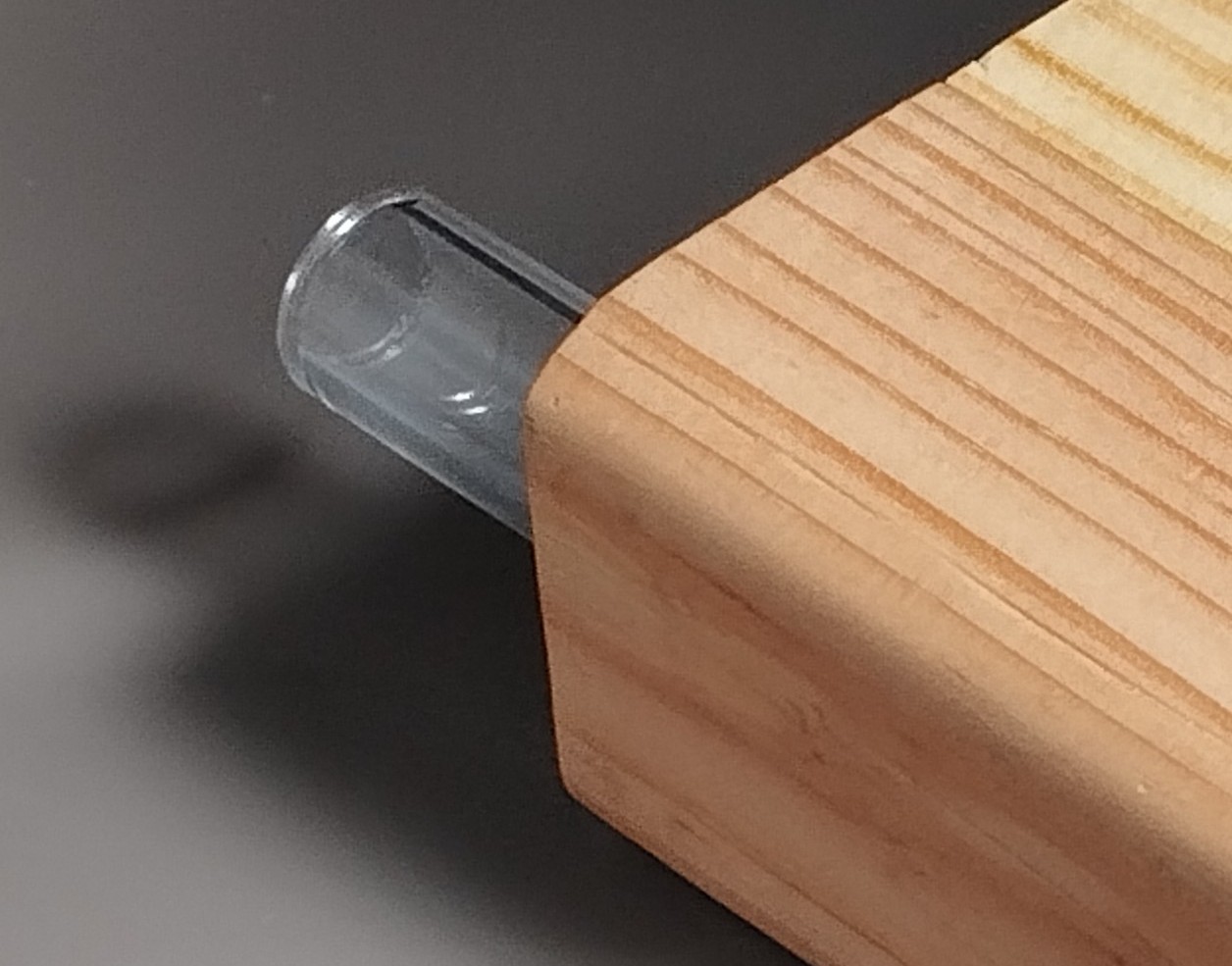
With softwoods out of the equation, I turned my attention to our local hardwood species, and carefully selected six great classics. They all come from PEFC certified forests and saw mills in France, ensuring their traceability and the use of sustainable practices in the entire chain, from growth to processing and down to the blanks I purchase from my suppliers. They are readily available year-round in sufficient quantities, allowing me to employ them as my standard woods.
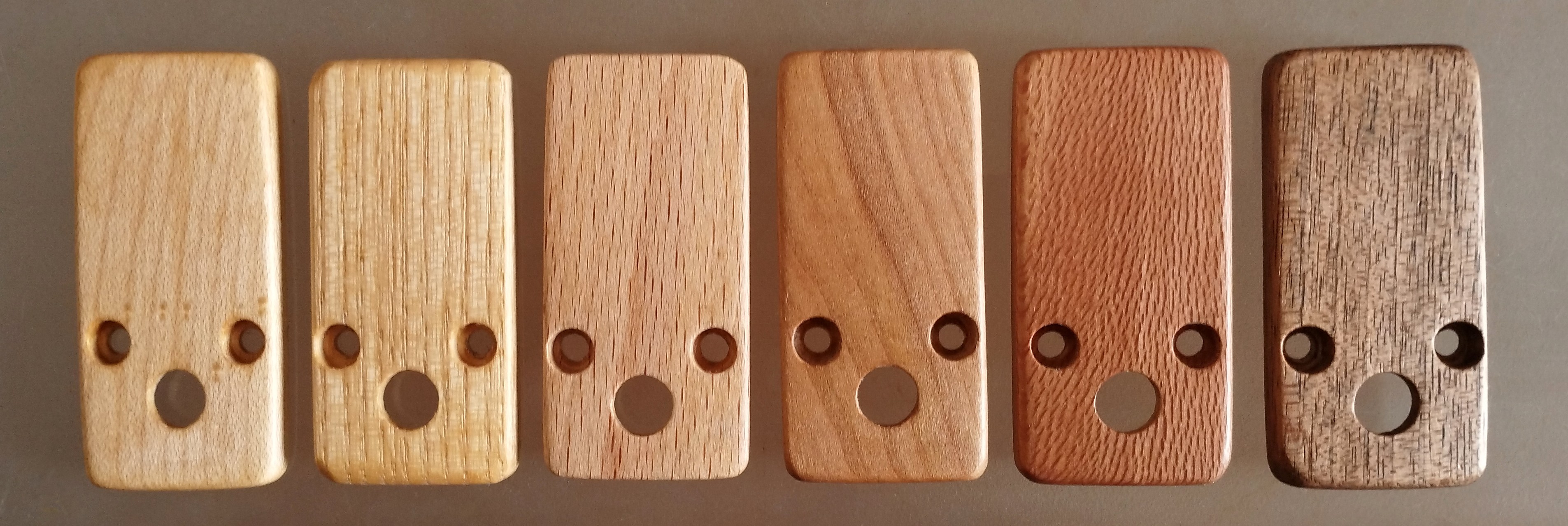
Let us have an overview of these six wonderful wood species that you can select for Ubik body and bottom plate. I tried to sort them from lightest to darkest, but keep in mind that there are always tone variations from tree to tree even inside a specific species, depending on many variables including growth conditions but also because they are all individuals like we are. And wood always changes color as it ages over time, it is a process you can only slow at best, but never fully eliminate.
Sycamore Maple
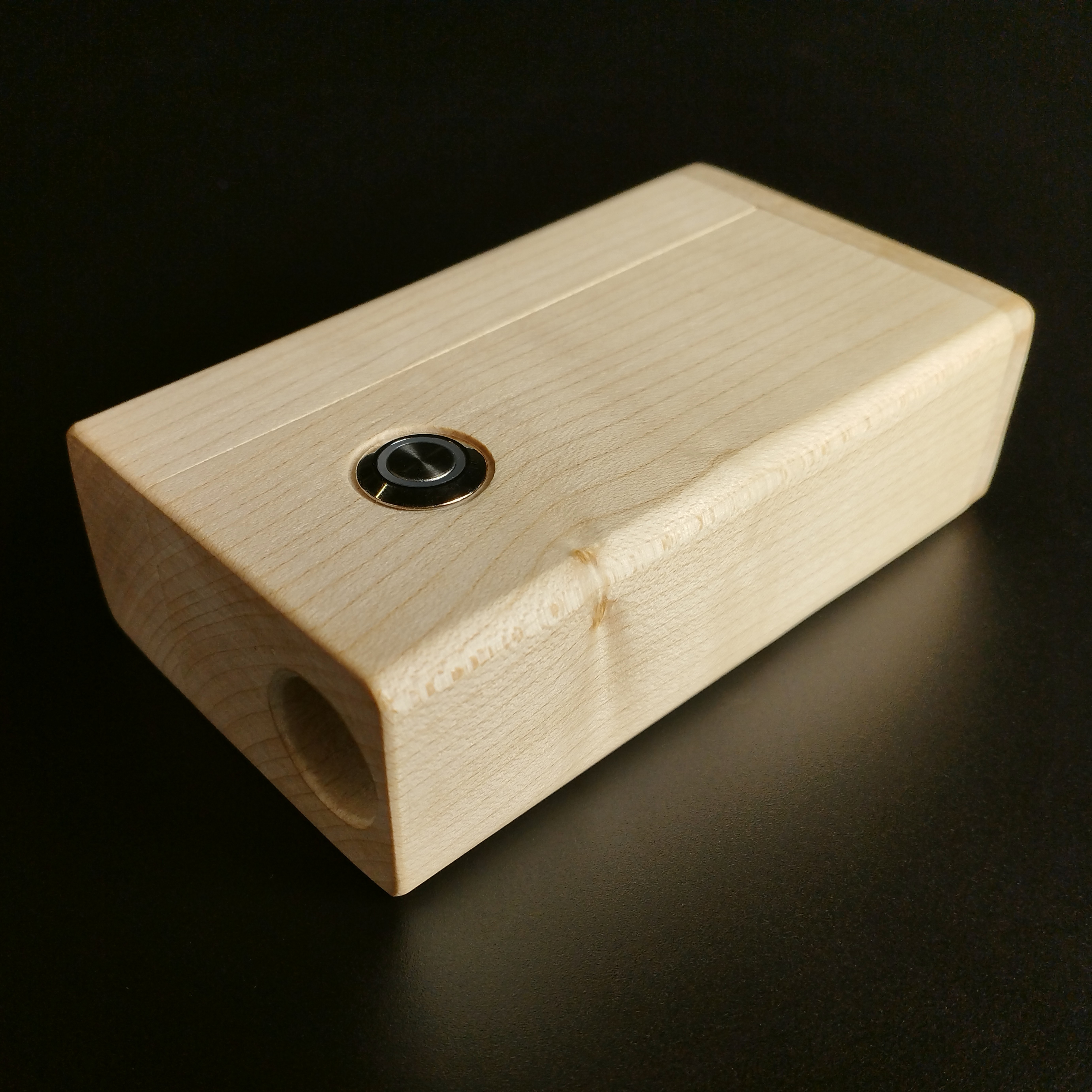
Maple has a very fine and closed grain. It polishes well and gives a satin surface with some light chatoyance at times, especially when it has some small healthy knots, which tend to create what I like to call a disturbance in the flow lines (as can be seen on the rounded front facing edge in the above picture)
Maple can develop naturally a lot of different figures, which are technically defects but much sought-after by cabinet and instrument makers, and those tend to increase its cost when they become piece-defining, like Wavy Maple or Birds Eyes Maple.
It has a very neutral smell and hardly affects the vapor taste. Note that this is the case for all my classics with the exception of Walnut. It starts as a creamy white color, but UV exposure will slowly make it turn more yellow over time, and this is probably its only drawback.
In Europe we do not grow much of the North American Sugar Maple, but we have three main alternative species that are better adapted to our climate. The one pictured here came from Austria and is not the exact species I will be offering, but once cut their woods are hardly distinguishable from each other.
European Ash
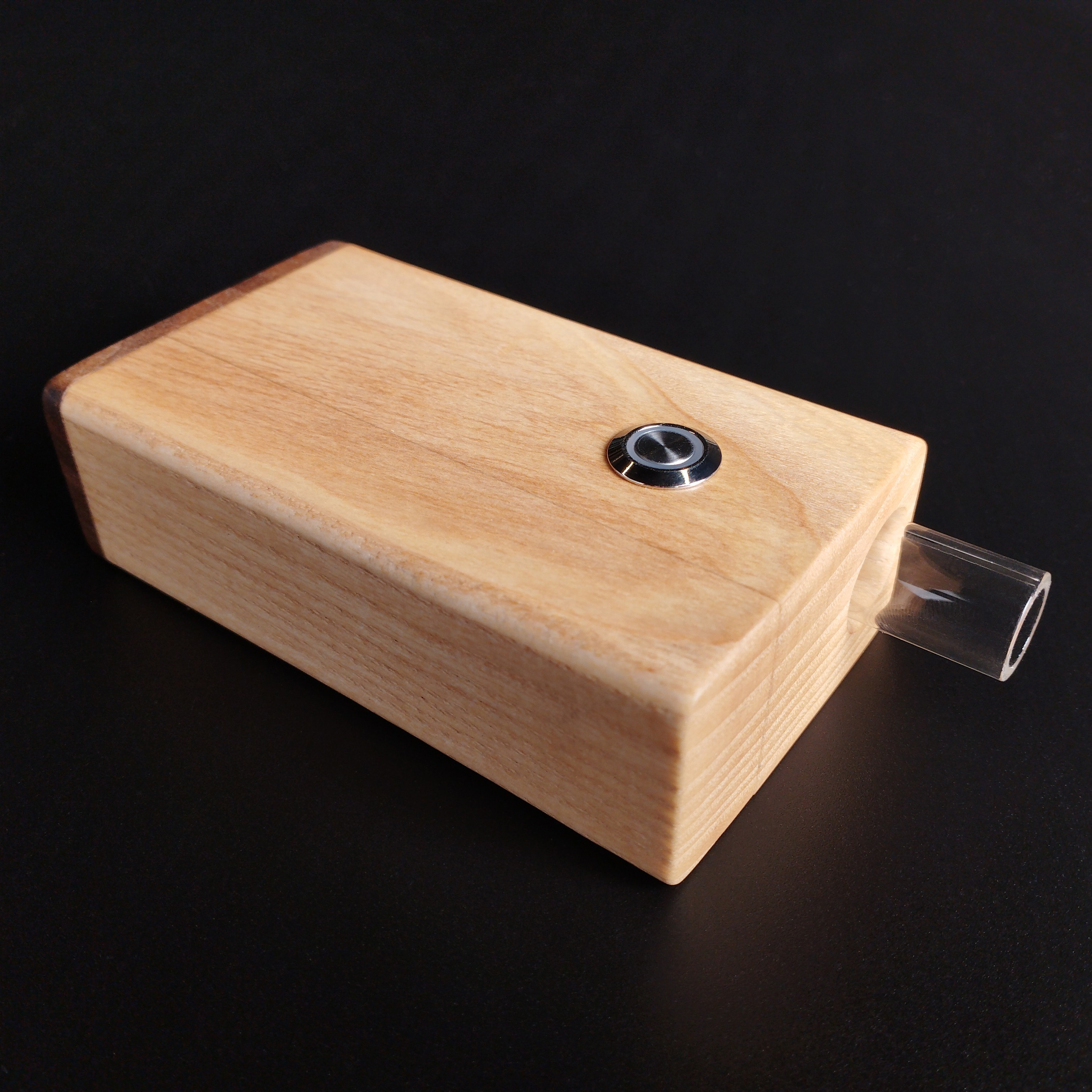
Contrary to Maple, Ash is an open grain wood, meaning its pores are larger and clearly visible. I fully fill them though when applying the finish, so the texture is perfectly flat and smooth to the touch, which can come a bit as a surprise when your eyes tell you to expect something with a rougher feel.
Its surface does not have much depth visually, it looks more like a plain canvas that was painted on and there are no color changing effects depending on light incidence. But when it is plain-sawn like in the above picture, with the faces almost parallel to the growth rings, interesting motifs appear when the plane crosses between successive wood layers.
The color starts off-white with reddish brown lines, and will darken over time towards something more like sand color with darker brown lines. The wood can exhibit some internal tensions (it is called sometimes nervous) but once released and settled it is quite stable in operation. It is also relatively dense, not too far off from some Oak species. It is in the same family as Olive tree.
Sadly the American Ash has been decimated by various plagues recently, and while the European Ash is doing better it is nonetheless listed as near threatened in the IUCN red list for Europe. In France it is listed as least concern as we still have larger naturally occurring populations, but with climate change its future is rather uncertain and it is under close watch.
European Beech
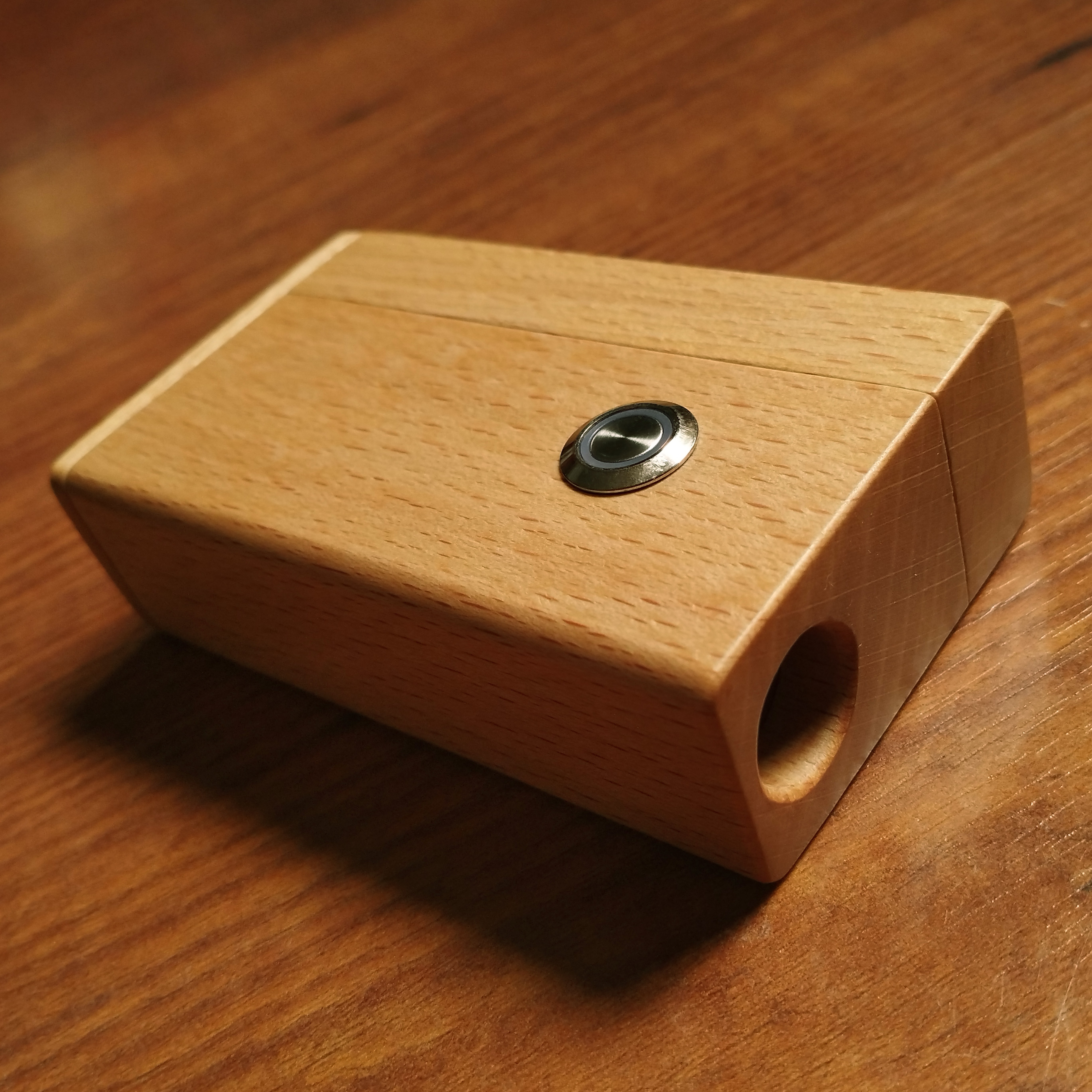
French Beech is widely regarded as premium quality, often comparable to or exceeding that of German and Austrian beech in specific applications, particularly regarding dimensional stability and machining precision. While we don’t have the largest growth surfaces, we are nonetheless amongst the top European exporters of highest grade Beech.
The wood is characterized by a straight, fine grain and a consistent texture. French Beech is noted for its pinkish-brown hue, almost salmon at times, which can be uniformly darkened to a deeper red through steaming. Pieces with red veins can be often found but tend to be rejected by the grading process, as furniture makers favor color uniformity. They do find their place in more artistic applications and smaller pieces like Ubik.
The surface has slightly more depth than Ash but the chatoyance is superficial at best. The characteristic small “dash lines” offer an interesting motif that becomes more or less visible depending on light incidence, going from clearly obvious to almost totally invisible. The end grain is very fine, with interesting radial rays showing perpendicular to the growth rings.
Beech has very good dimensional stability, and while its color will darken somewhat with age, it is more stable than other species. It is the wood with the least detectable smell amongst the six, certified for food contact and children toys. Used widely in Europe to smoke various foods.
Wild Cherry
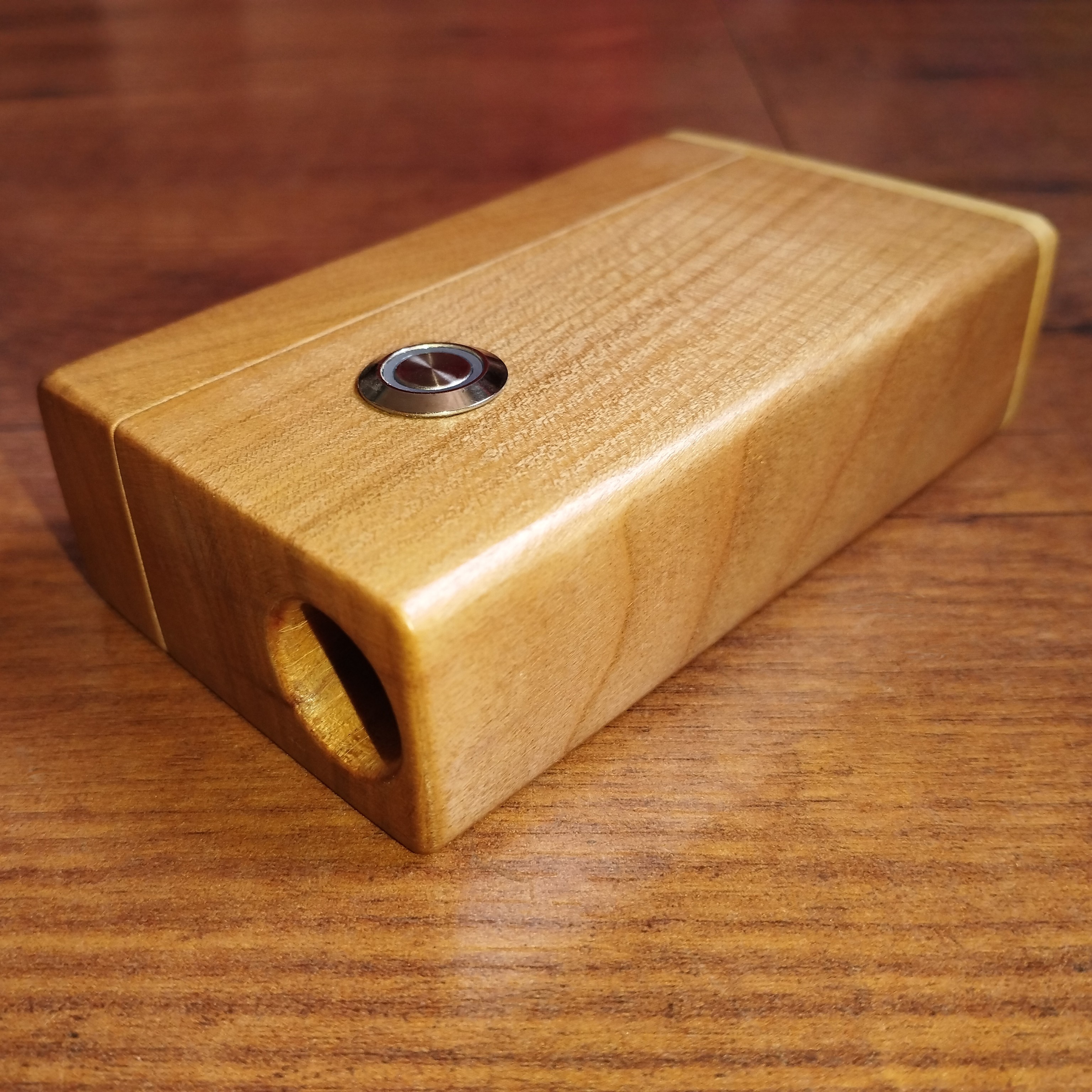
Cherry and Wild Cherry are the same botanical species, but cultivars selected for fruits production grow shorter to make harvest easier and are encouraged to develop many lateral branches, making their wood more knotty. While Cherry trees found in the wild inside forests grow much straighter and taller to compete in the canopy and provide usable wood in more commercial quantities.
The color starts almost golden with reddish undertones, but the change over time can be quite drastic and it will turn a much darker and richer red brown color. The chatoyance on this species, especially on quarter-sawn surfaces like shown above is very deep, like if it was filled with metallic golden pigments playing with the light. It creates lovely color-changing effects.
There are more color variations between individuals than some of the other classics though. Some can have copper hues, some even hints of a greener tint. Some have more marked veins. It is a species full of surprises!
European Sycamore
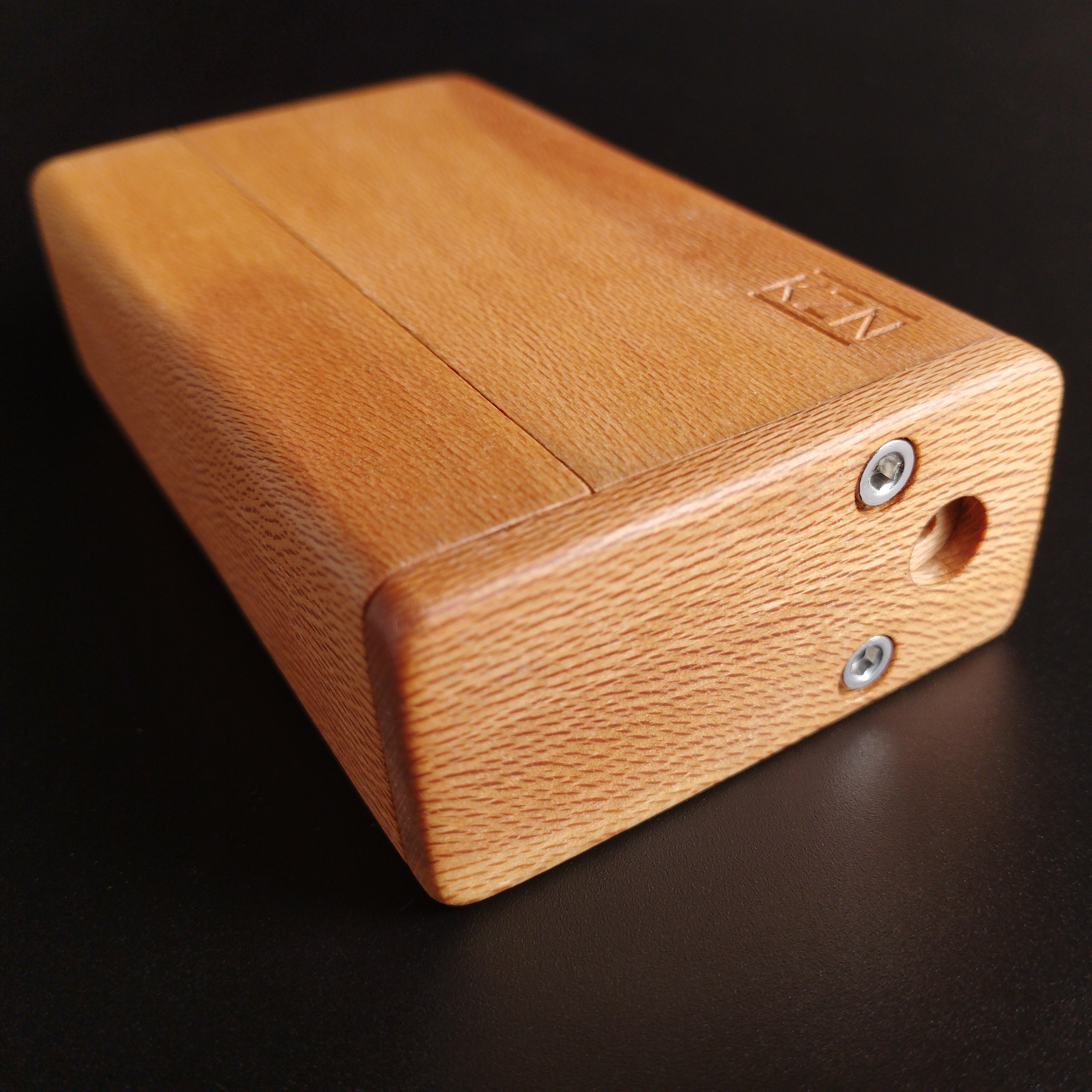
If you ever visited South France, chances are you crossed those majestic trees that have provided ample shade to countless generations. You can not miss their camouflage looking patterns on their otherwise smooth bark. They can grow quite large, widespread and massive, but have a bad tendency to develop hollow trunks with age and often have to be taken down.
They have been planted everywhere, to line roads, as well as inside and outside cities. Sadly during the last century they have been struck very hard by several pathogens and diseases, so much that containment plans have been established nation-wide and when any infected tree is detected, all others individuals in a 500m radius have to be cut and incinerated, often incurring a high cost to their owners.
A personal favorite of mine, its wood is quite under-rated and not as readily available as one could imagine. Some urban legends claim that since they border many roads and village places, they can end with rocks and even metal pieces embedded inside them and it is the bane of saw mills as it can destroy their blades. But it is nonetheless stocked year-round by one of my major suppliers.
The wood shows properties comparable to Beech, but with a considerably darker hue going from orange to deeper red with non-uniform zones. The color can be enhanced by a steaming process too. It polishes to a very smooth surface and its most striking feature is its organic looking dots motifs that at times reminds me almost of some kind of lizard or other animal skin. But like Beech the surface is rather plain with only shallow chatoyance, yet achieving a glossier finish overall.
European Walnut
European Walnut has nothing to envy to its North American cousin, the Black Walnut. Its latin name is Juglans regia, derived from “Jupiter” for the genus name, and “royal” for the species name. In the early and mid-1900s, France was consistently the leading walnut producer in Western Europe, and it lasted approximately until the fall of USSR. Trees were grown primarily for their nuts, but they always were a source of premium timber too.
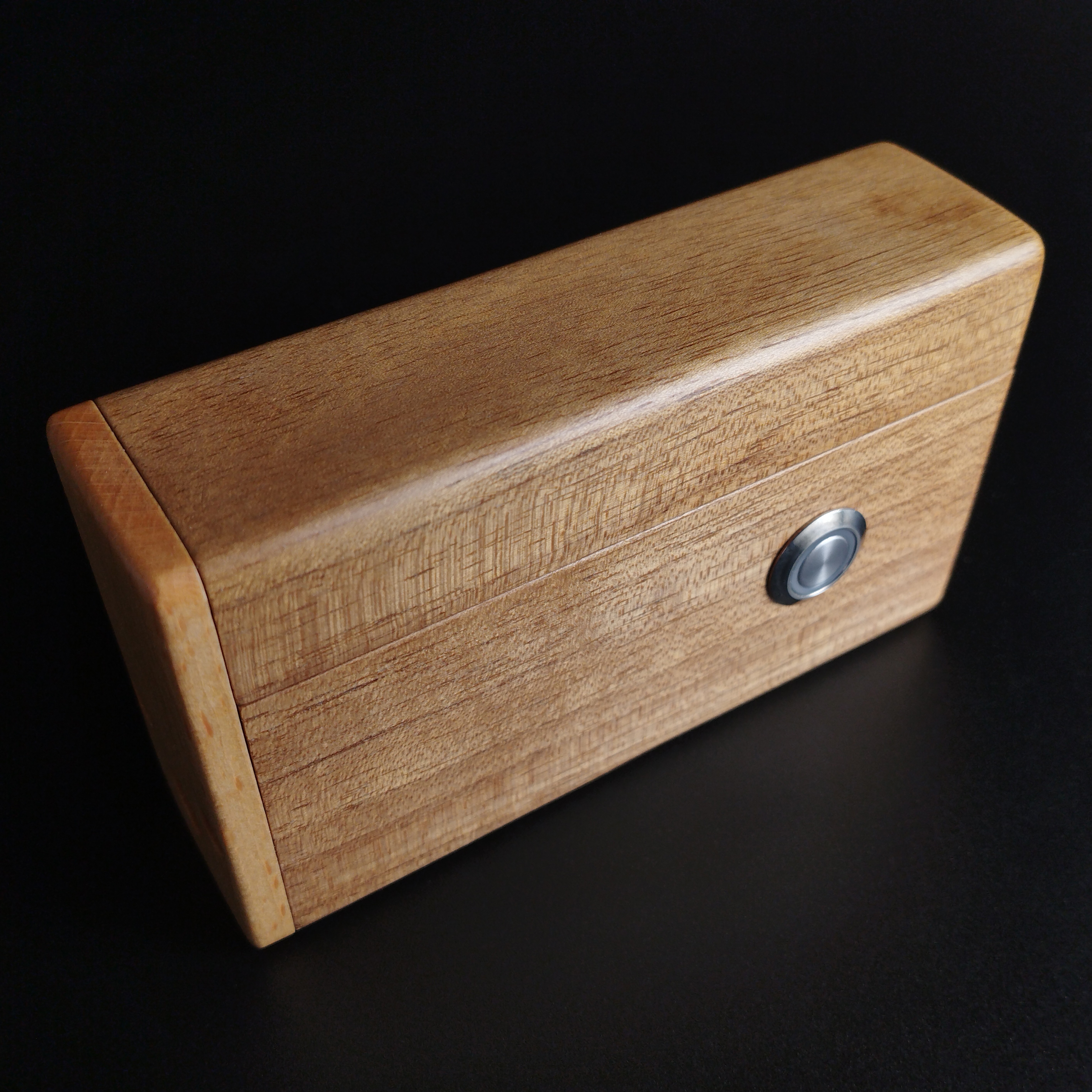
Of the six classic woods this is the one with the highest variability in figure and color, but it is nonetheless the darkest. When quarter-sawn like above it can display nearly as much chatoyance as Cherry, and this particular Ubik goes from an incredibly light golden tone to a deep rich dark brown depending on light incidence.
It is technically an open-grain wood like Ash or Oak, but it is more obvious when plain-sawn. It is moderately hard but has good dimensional stability. It polishes to a very smooth surface. Some pieces can show quite pronounced figures, including burls which fetch the higher prices, and are for obvious reasons not part of the standard offering.
Undoubtedly a favorite if you enjoy dark woods, it does have two drawbacks though: you should avoid it if you have any tree nuts allergy, and of the six classics it is the one having the most pronounced smell. I personally like it but it might not be the case for everyone else.
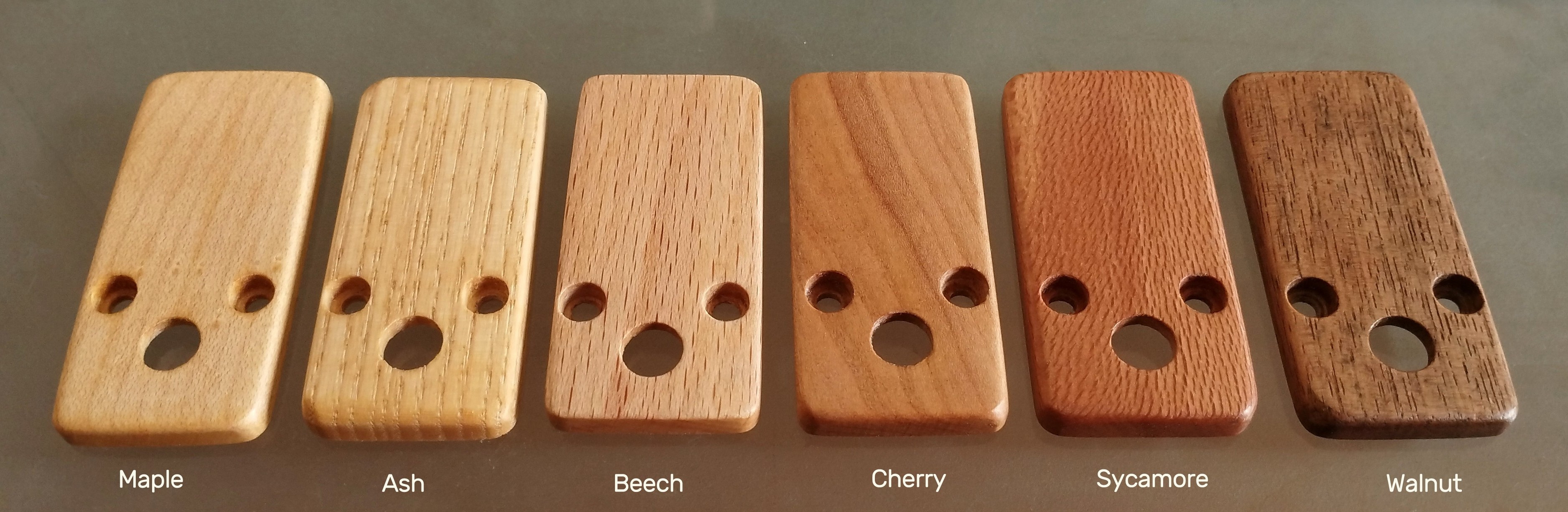
Since these six classics all have their own qualities that I would like to showcase, I want to let you chose them freely depending solely on your feelings and preferences but not on their cost. This is why I decided to offer them all at the exact same entry price.
In a future article we will dive deeper into the possible body and plates combinations, as some work clearly better than others, while some only work when properly tone-matched, and some are too close yet different and don’t pair well at all.
But I will be there to help you decide in all cases.